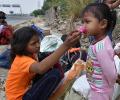
There was no announcement from the government on guaranteeing a minimum basic income, which is the need of the hour. The announcements on portability of ration cards and affordable rental housing to workers are for the long and medium terms. Migrant workers need immediate relief.

Later, there may be some tax relief aimed at the middle class and measures to benefit the sectors worst hit by Covid-19 and the resultant nationwide lockdown.

The Karnataka government is also expected to follow suit and withdraw its decision to raise the variable DA.

There could be multiple measures announced in quick succession, not only by the finance minister but also other ministers regarding their respective sectors, and by the Reserve Bank of India. The total size of these announcements could rival that of other G-20 nations as a percentage of GDP.
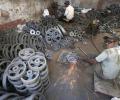
11 categories of industries will be exempt from the Madhya Pradesh Industrial Relations (MPIR) Act of 1961. This includes textile, leather, cement, iron and steel, electrical goods, sugar, electricity, public motor transport, engineering including manufacture of motor vehicles, among others.

'Just as coronavirus has come to us from China, this disease is also coming from that country.' 'India is a strong democracy and you cannot compromise on labour laws in this manner.' 'These changes will be challenged in court.'
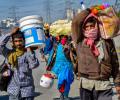
Unlike the other Bharatiya Janata Party-led governments, Assam has not proposed doing away with most labour laws for a certain number of years. Instead it has proposed introducing fixed-term employment to help both workers and industries, and seeks to take more firms out of the ambit of laws governing factories and contract workers.
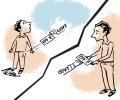
Apart from this, employers may be allowed to deduct EPF contributions only on the basic pay of up to Rs 15,000, even if the employees' basic pay is above this ceiling. While on one hand this will allow companies to lower their wage bills, employees can also get a higher salary in hand.

The finance minister is ready to present a second financial package. The Centre has ruled out a mega stimulus and will rely on targeted, incremental packages. Industry is clamouring for a bailout, the liquidity upheaval in capital markets is nowhere close to being sorted out, and all budgetary forecasts now stand irrelevant, reports Arup Roychoudhury.
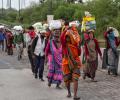
The beneficiaries of the second set of announcements are expected to be micro, small, and medium enterprises, farmers, women, poor, migrant workers, and other marginalised sections of the society, reports Arup Roychoudhury.
The portal, which has been tentatively named by the labour and employment ministry as the National Portal for COVID-19 Affected Unorganised Migrant Workers, will gather the details of all the unorganised sector workers who are stranded in relief camps, residential or industrial clusters.

'The numbers are null and void now. Look, we can give out projections now, but we know that a week later those numbers will also be irrelevant. So we need to wait,' a top government official said.
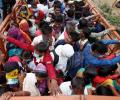
Parliamentary standing committee on labour, led by Biju Janata Dal MP Bhartruhari Mahtab, has said in its report that it is unjustifiable for owners to pay workers' wages during natural calamities.

A government official said out that with hardly any economic activity, an immediate duty hike will not be productive and could be announced once the lockdown eases and demand revives.

This is because the bond market has factored in the Rs 4.88-trillion gross borrowing for April-September 2020.
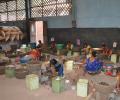
Ensuring health insurance for all workers would be major challenge for the industry that is already grappling with cash crunch, and the government should have borne the cost.

Daily wagers are running out of resources, including ration and cash, and the state governments might not be able to sustain their needs for a longer period of time, given the lockdown has already been extended until May 3.

The stimulus package is expected anytime this week and will be aimed at the urban and rural poor; disadvantaged sections of society; MSMEs and some of the worst-affected sectors.
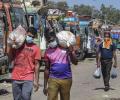
It is likely the government will divide the country into different zones during the proposed extended period of lockdown and might permit a few services to function in safe zones.
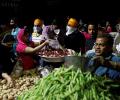
There have been several instances of traders dumping fruits and vegetables outside mandis. Or of farmers dumping produce outside their villages or feeding them to their animals.
 © 2025 Rediff.com - Investor Information - Advertise with us - Disclaimer - Privacy Policy - Sitemap - Feedback - About us - Terms of use - Grievances